The New Jerusalem

[This the fourth in a series of reflections on the presentations at the Chautauqua Institute, August 16-23. 2025]

Revelation 21:1-4

1Then I saw “a new heaven and a new earth,” a for the first heaven and the first earth had passed away, and there was no longer any sea. 2I saw the Holy City, the new Jerusalem, coming down out of heaven from God, prepared as a bride beautifully dressed for her husband. 3And I heard a loud voice from the throne saying, “Look! God’s dwelling place is now among the people, and he will dwell with them. They will be his people, and God himself will be with them and be their God. 4‘He will wipe every tear from their eyes. There will be no more death’ b or mourning or crying or pain, for the old order of things has passed away.”

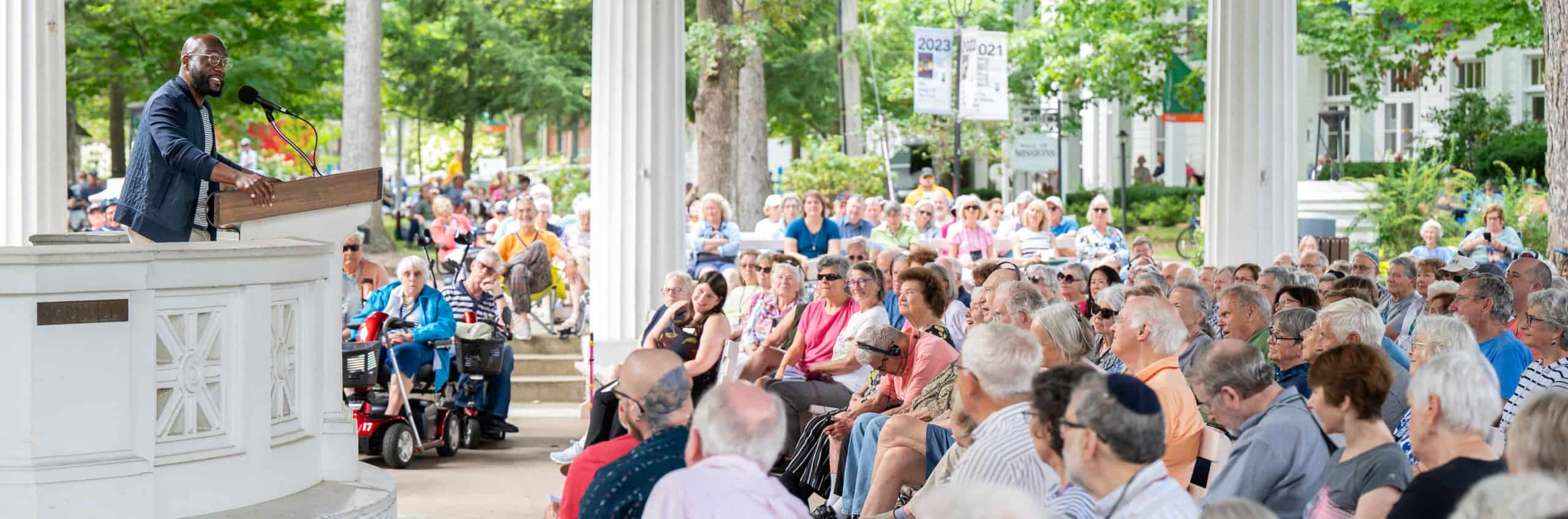
The words of Revelation are not a vision of another place, Brian McLaren said at Chautauqua on Friday, his last day preaching. The Holy City is coming down out of heaven from GodIt is a vision of the here and now, because God’s dwelling place is now among the people.  After all, what do Christians and other people of faith mean by the Holy Spirit? A present and available presence of God.

Many readers of the book of Revelations consider it a future deliverance and many think of it as an empty promise, but McLaren considers it a literature of the oppressed, describing the travail of people enslaved by Rome and abandoned by the religious establishment. On Thursday he connected it to the Epistle to the Romans written by Paul, referring to the travail of this earth at this moment:

22 We know that the whole creation has been groaning as in the pains of childbirth right up to the present time. 23 Not only so, but we ourselves, who have the firstfruits of the Spirit, groan inwardly as we wait eagerly for our adoption to sonship, the redemption of our bodies. 24 For in this hope we were saved. But hope that is seen is no hope at all. Who hopes for what they already have? 25 But if we hope for what we do not yet have, we wait for it patiently (Romans 8: 22-25).

These “pains of childbirth” promise a joyful fulfillment, just as the birth of a child promises joy, said McLaren. We all suffer together, we all hope for a future deliverance, the “firstfruits” of the Spirit” promised by Revelations,  but we hope together for the “adoption . . redemption” and to be saved. This promise is already coming to fruition. It is not a distant hope, because God’s dwelling place is now among the people, and he will dwell with them (Revelations 21:3).

If you read Life After Doom, you discover that we are not only passive recipients of this kingdom, but participants by our growing as a community of believers. Isolation can breed some of the ugliness in the world.  McLaren recalled the ugliness that crowded in on him when he watched the news or read the contemptuous messages on social media.  He noticed a certain addiction to that kind of ugliness. It fed something inside him like a chemical addiction: “Ugly news caused stress, which likely reduced my levels of the hormone serotonin, leading to less happiness and more depression. . . .

The less happiness I felt , the more I needed likes on social media as rewards for posting outrage about an outrage, or the more I needed to feel a deep belonging to an outraged in-group or the more I needed to fight with somebody about something” (p. 214).

Could this be our predicament? Alienated by the media that was supposed to connect us? Is this the world we need to be delivered from, the world that groans for a better future?

What McLaren found was traces of beauty in a fallen world. First: to notice  and celebrate the beauty of the creation, the glory in the trees, the birds, the rivers and lakes, all available at once.

Second is the community outside of social media that needs no wired or wireless connection. They are small groups dedicated to advancing the stories of ecological, social and spiritual harmony. He talked about groups that formed spontaneously, like a campfire meeting with stories and songs. He referred to groups that met periodically for a shared purpose: service, expressions of art and writing, reading groups, reflecting on scripture.  These can create their own beauty. They can bring the kingdom we were urged to pray for when Jesus said, “Thy kingdom come.”

The coming of the New Jerusalem begins with the commitment of its followers.  Then the wiping away of the tears. Then the end of mourning or crying or pain. It call s forth the hope of what we do not see.

Who hopes for what they already have? 25 But if we hope for what we do not yet have, we wait for it patiently.
Life at Chautauqua

Our third journey to the Chautauqua Institute may be the most anticipated. We are slicing off a ten-day chunk of Chautauqua’s lecture series because we wanted to hear Tom Friedman, NY Times foreign correspondent, at the end of Week 8 and Doris Kearns Goodwin, American history biographer, at the beginning of Week 9.

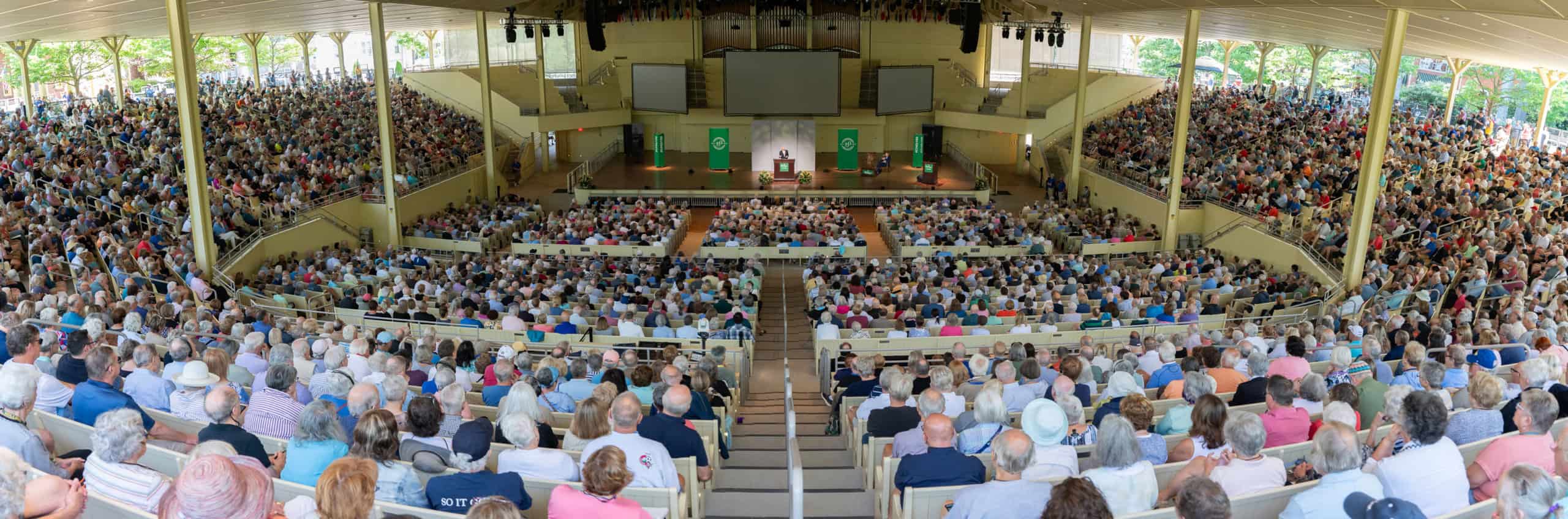
Friedman caps off a week on the Middle East and Kearns Goodwin kicks off a week on the lessons of history for the present.Then on Tuesday, a Blues performance by a group organized by Morgan Freeman. It looks like this, but typically an audience about three-quarters this size.

A crowded amphitheater for a morning lecture
Thomas Friedman Fri, Aug 15, 2025 10:45 AM
Doris Kearns Goodwin Mon, Aug  18, 2025  10:45 AM
From Delta Roots to Symphonic Heights: Inside Morgan Freeman’s Symphonic Blues Experience Tue, Aug 19, 2025 10:45

We are staying at Paul Manor, an adapted Victorian house  right off the main plaza, which has a bookstore, a library,  boutiques, food concessions, restaurants, kind of like an upscale college campus. From the photo below our residence is off to the upper right, barely a block from Bestor Plaza.

On other mornings we hear some lesser-known speakers, but they are often pleasant surprises, because of their fresh perspectives and specialties.

Earlier at 9:15 we enjoy a half-hour ecumenical worship service with a chaplain of the week. The chaplain delivers a brief sermon, which follows the theme of the week, so it is like a a spiritual warm-up. On Week Ten the chaplain is one of my favorite spiritual writers, Brian McLaren, author of Faith After Doubt and Do I Stay Christian? His current book has the provocative title Life After Doom.

That is what at morning at Chautauqua looks like.

In the afternoons they invite speakers to Philosophy Hall for the Interfaith Lecture Series. This venue is about one-fifth the size of the Amphitheater with seats outside as well as under the roof:

Ubaydullah Evans giving an Interfaith lecture to a crowd in the Hall of Philosophy
Last year we heard Miroslav Volf, founder of the Yale Center for Faith and Culture (https://faith.yale.edu/people/miroslav-volf). His web page photo is very stark. He has a warmer demeanor. Among his many books: The End of Memory: Remembering Rightly in a Violent World (2006; revised edition, 2020), winner of the Christianity Today Book Award.

At night we attend concerts ranging from symphonic to folk-rock or a featured play for the summer. Last year they featured an amazing production of Wynton Marsalis’s jazz-symphony “All Rise,” including jazz and symphonic instruments and a choir. That performance celebrated the 150th Anniversary of Chautauqua, and it was videotaped. It can be seen on the PBS streaming platform “PBS Passport.”

I hope this makes the Chautauqua experience a little more vivid. It is not an inexpensive week of your summer, but it is a beautiful setting: illuminating, entertaining, and relaxing as you choose your activities. We are really anticipating these final ten days of the summer season this week and next. Stay tuned for reports on the speakers.


Vulnerabilty of Faith

Faith 1 -Unquestioning belief that does not require proof of evidence

[Websters New World College Dictionary, Fourth Edition, Michael Agnes, editor in chief, Cleveland: Wiley Publishing Company, 2010.

Faith – Now faith is the assurance of things hoped for, the conviction of things unseen. By faith we understand that the worlds were prepared by the word of God, so that what is seen was made from things that are not visible.Hebrews 11: 1-2

Jesus had two disciples. Well, he had twelve, but this is an interesting pair. One was brash and confident. He walked on water. He promised he would always be faithful. He proclaimed ““You are the Christ, the Son of the living God.” Then he denied Jesus when he really needed him.

The second one was always asking questions, “Lord we do not know where you are going. How can we know the way?” And challenging facts, “Unless I see the mark of the nails in his hands and put my finger in the mark of the nails and my hand in his side, I will not believe.” After he had witnessed these things he said, “My Lord and my God!”

One of these disciples is Peter—known as “the Rock,” the other is Thomas, known as “Doubting Thomas.” Are they both models of faith or should our model be Peter, because Jesus said to Thomas.” Blessed are those who have not seen and yet have come to believe”? (John 20:31). Thomas had to see. Does he lose points for that?

Christians do not always mean the same thing when they say someone “has faith.” “Faith” can mean what most dictionaries proclaim: Unquestioning belief that does not require proof of evidence. In this interpretation faith is a sturdy resolve, relying on “signs,” unshaken by ordinary circumstances. By “signs” I mean something more than mere evidence. Sometimes Christians will say they have a “call,” a “leading,” a “word,” some indication beyond physical evidence. That is how they detach from the “world.”

Jesus often asked for faith before he would heal (Matthew 9:28; Mark 9:23; Luke 8:50; 17:19), but in one case he said” All things can be done for the one who believes,”and the father of the boy with convulsions cries in desperation, “I believe; help my unbelief!” Jesus proceeds to cast out the demon possessing the boy. How many desperate, yet skeptical, people have quoted those words back to God? I believe! Help my unbelief!

The episode leaves us with a paradox. Is “Help my unbelief!” enough? What does God consider “faith? In the only definition of faith in the scriptures The Epistle to the Hebrews says, “Now faith is the assurance of things hoped for, the conviction of things unseen.” What sense can we make of this? “Assurance” but “hoped for”? “Conviction” but “things unseen”? The writer seems to say we have confidence, but not in facts or certainties. Faith may be assertive, but not based on hard evidence, but “things hoped for” and “things unseen.”

Are we living with guarantees or questions, certainties or uncertainties, signs or wonders? Practicing faith can be trickier than asserting what we believe. Do we use Peter as our model, the confident, determined, yet caving under pressure? Or do we use Thomas as our model, questioning, stubbornly skeptical, yet willing to be convinced? Yes, they both were reassured by Jesus, but each practiced a different faith. What is ours?

Another model of faith reveals the gamut from miracle to mystery. Miracles have traditionally been the visible signs of authenticity of faith, i.e. the visible presence of God. Yet Jesus was not always a proponent of miracles: Asked to perform a sign (miracle), Jesus said, “An evil and adulterous people asks for a sign, but no sign will be given to it except the sign of the prophet Jonah.” (Matthew 12:39). The “sign of Jonah” was no miracle, but that is another story, coming up later.

The “mystery” of faith is more subtle, often personal. We can see the gamut from miracle to mystery in the life of the prophet Elijah. Elijah was famous for confounding the idolatrous King Ahab with miraculous signs of God’s power. He challenged the false prophets to ignite a sacrifice of a bull by praying to Baal. The prophets took extreme measures, including cutting themselves with swords and lances, but no fire came (I Kings 18:28).

Elijah changed the altar by lining it with twelve stones, two measures of seed, and the cut-up bull. Then he saturated the altar with water and prayed. “Then the fire of the Lord fell and consumed the burnt offering, the wood, the stones and the dust and even licked up the water that was in the trench.” (18:38). The episode ends with the slaughter of the prophets of Baal, and the end of a horrible drought, showing the power of Yahweh over Baal.

Then a strange turn to the story sends Elijah running. Queen Jezebel threatens his life, and he retreats to the wilderness. He is revived by angels twice, but he prays for God to take his life in the face of the dire threats of Jezebel. The narrative reminds me of the vulnerability of faith that it can rise to the miraculous and plunge to suicidal in a matter of a day.

Elijah flees to Mount Horeb, where God summons him to stand on the mountain to witness God’s presence. Several natural phenomena follow: a wind, an earthquake, and a fire, all of which do not reveal God’s presence. Elijah’s next experience has been variously translated a “sheer silence,’ a “still, small voice,” “a gentle little breeze,” “the sound of a light whisper.” (The Harper Collins Study Bible: Fully Revised and Updated, Harold W. Attridge, editor, New York: HarperOne, 2006.).

Depending on your translation, either God did not answer, or God answered in a mysteriously understated way that Elijah had never experienced. Even so, it gave him the courage to find Jehu and anoint him as king and Elisha to anoint him as his successor prophet. At the very least the story suggests that God’s presence might be less dramatic and more mysterious.

The extreme differences in God’s revelation to Elijah illustrate the difference between the miracle, i.e. the ignition of the saturated sacrifice, and mystery, the faint sound of the still, small voice. As a child I was taught that God was a still small voice, so we had to pay attention.

Does a miracle in our presence make God a certainty? Even miracles may be subject to skeptical examination. The feeding of the five thousand can been rationalized as people spontaneously sharing their food. Does the mysterious voice in our minds/ hearts prove God’s power/ desire to guide and comfort? Nothing is certain about faith, except the willingness of minds and hearts to accept the miracle or the mystery.

Help my unbelief!


The Gathering

While we were in Italy this past June we fretted some about our living room skylight which had sprung a leak during the recent high winds/ tornado that swept through St. Louis. It didn’t gush, but it dripped into the middle of the living room and would have soaked the sectional sofa and the rug if we didn’t put down a drop cloth, some towels, and some kitchen bowls to catch the drips. Pretty good protection, but who knows what surprises lurked in the porous skylight?

Whom could we ask to check on the status of the leak? We had some candidates, but we kept thinking of reasons they wouldn’t be available. We could have just sent out an e-mail to a group of people to see if any were available, but we just didn’t know enough neighbors that we could call on for a possible, but not definite, emergency.

When we returned home the leak hadn’t gotten worse, so no harm, no foul. But what about the neighborhood question?

Two years ago we had organized a “gathering” on July 4 for the immediate neighborhood, and it attracted eighteen people, some familiar, several completely new acquaintances. That was a good foundation for a neighborhood of people we could call “friends,” but we didn’t follow-up a year later, so it yielded a circle of people we could wave to as we walked the neighborhood. Victoria remembered most of the names, as she typically does with new acquaintances. I needed some prompting . . . .

So we organized another “gathering” this year on the Fourth of July. Pretty much the same strategy . . . emailing those we knew from the previous gathering, taping invitations on local doors of some we didn’t know, encouraging neighbors to invite their friends. We didn’t ask for RSVP’s because we wanted to keep it informal, not obligatory.  We saw one or two people on the street who said they were coming.

We were delighted on the morning of the Fourth by a constant stream of neighbors coming in to our backyard between 9 and 10 a.m. Including ourselves, we made two dozen for the 2025 gathering, pretty much filling our patio. Several had come because their neighbors invited them. Some came who were invited to the previous gathering, but couldn’t come that year. Some came who were widows or empty nesters. Some had lived here a few months, some for more than forty years.

Near the end of “The Gathering” Victoria invited each neighbor to give a brief story of when they came here, where they came from, and who else was in their family. She organized them geographically, so each street, north, south, east and west, spoke as a group. The breakdown showed us that we had friends in every direction from our house. The Gathering was also a geographic community. It felt as though everyone had a desire for a real neighborhood. For all  their family ties they still wanted a local connection, more than people you could wave to as you walked the streets.

This year several people talked about what we should do “next year.” That made us happy, though a little responsible. We started thinking of ways to expand the patio area, how to cut back on the oversupply of coffee, bagels and donut holes. We even started to think this should happen more than once a year.

And we started to think about whom we would call if the roof leaked when we were away.


Quiet Betrayal

July 4, 2025. In an article by Anne Applebaum today’s Atlantic warns that the US is ceding Ukraine to the Russians.  Normally I would not shamelessly appropriate another writer’s work, but the warning inherent in her  story is too important to dilute with my my own commentary.

The current news that the U.S. is withholding weapons promised by the Biden administration is only the most visible betrayal of Ukraine’s struggle for survival.  We are withdrawing all means of support like an ebbing tide.

See excerpts from Applebaum’s article below:

  • how sanctions are useless without vigilance to Russia’s shell game
  • how the loss of international outlets such as Radio-free Europe has left the air waves open to the Russian narrative
  • how the failure of the Trump administration to filter Putin’s talking points turns us away from Ukraine

The Great Realignment

Trump is giving the Russian dictator every incentive to keep killing Ukrainians.

Photo-illustration of Donald Trump and Vladimir Putin shaking hands with a map of Ukraine behind them
Photo-illustration by The Atlantic. Sources: Chris Ratcliffe / Bloomberg / Getty; Getty.
Updated at 7:20 a.m. ET on July 4, 2025

. . . Putin sees what everyone else sees: Slowly, the U.S. is switching sides. True, Trump occasionally berates Putin, or makes sympathetic noises toward Ukrainians, as he did last week when he seemed to express interest in a Ukrainian journalist who said that her husband was in the military. Trump also appeared to enjoy being flattered at the NATO summit, where European leaders made a decision, hailed as historic, to further raise defense spending. But thanks to quieter decisions by members of his own administration, people whom he has appointed, the American realignment with Russia and against Ukraine and Europe is gathering pace—not merely in rhetoric but in reality.

Just this week, in the middle of the worst aerial-bombing campaign since the war began, the Trump administration confirmed that a large shipment of weapons, which had already been funded by the Biden administration, will not be sent to Ukraine. The weapons, some of which are already in Poland, include artillery shells, missiles, rockets, and, most important, interceptors for Patriot air-defense systems, the ammunition that Ukrainians need to protect civilians from missile attacks. Trump had suggested that he would supply Ukraine with more Patriot ammunition, which is an American product. “We’re going to see if we can make some available,” he said after meeting Ukrainian President Volodymyr Zelensky last week. But what he says and what his administration actually does are very different.

Pentagon spokespeople have explained that this abrupt change was made because American stockpiles are insufficient, an excuse disputed both by former Biden-administration officials and by independent policy analysts. But whether true or false, this reasoning doesn’t matter to the Russians, who have already interpreted this change as a clear signal that American support for Ukraine is ending: “The fewer the number of weapons that are delivered to Ukraine, the closer the end of the special military operation,” the Kremlin spokesman Dmitry Peskov told reporters. To be clear, by “the end of the special military operation,” he means the defeat of Ukraine.

At the same time, and with much less publicity, the U.S. is essentially lifting sanctions on Russia. No such formal announcement has been made. But the maintenance of sanctions requires constant shifts and adjustments, as Russian companies and other entities change suppliers and tactics in order to acquire sanctioned products. During the Biden administration, I spoke several times with officials who followed these changes closely, and who repeatedly issued new sanctions in order to counter them. As The New York Times has reported, the Trump administration has stopped following these shifts and stopped imposing new sanctions altogether. This, the Times writes, allows “new dummy companies to funnel funds and critical components to Russia, including computer chips and military equipment.”

In addition to taking Russia’s side in the kinetic war and the economic war, the U.S. is realigning its position in the narrative war, too. During the Biden administration, the State Department’s Global Engagement Center regularly identified Russian disinformation operations around the world—exposing misleading websites or campaigns secretly run or directed by Russian operatives in Latin America and Africa, as well as in Europe. Trump appointees have not only dissolved the center; they also baselessly and bizarrely accused it of somehow harming American conservatives, even of having “actively silenced and censored the voices of Americans,” although the GEC had no operations inside the U.S.

At the same time, cuts to USAID and other programs have abruptly reduced funding for some independent media and Russian-opposition media. The planned cuts to Radio Free Europe/Radio Liberty, if not stopped by the courts, will destroy one of the few outside sources of information that reaches Russians with real news about the war. Should all of these changes become permanent, the U.S. will no longer have any tools available to communicate with the Russian public or counter Russian propaganda, either inside Russia or around the world.

Inside the United States, Russian propaganda is most loudly and effectively promoted by appointees of the U.S. president. Steve Witkoff, the real-estate developer who became Trump’s main negotiator with Russia despite having no knowledge of Russian history or politics, regularly echoes false Russian talking points and propaganda. He has repeated Putin’s view, which he may have heard from the Russian president himself, that “Ukraine is just a false country, that they just patched together in this sort of mosaic, these regions.” Witkoff has also seemed to agree with Putin that Ukrainian territories that voted for independence from Moscow in 1991 are somehow “Russian.”

By accepting disputed claims as fact, Witkoff is also helping Putin continue his war. In order to keep Russians onboard, to create divisions among Ukraine’s allies, and maybe even to build doubts inside Ukraine itself, Putin needs to portray the Ukrainian cause as hopeless and to describe the Ukrainian “demands” as unreasonable. He has to hide the most basic facts about this war: that he began it, that he has killed hundreds of thousands of people in pursuit of it, and that his goal, again, is to destroy or decapitate all of Ukraine. Witkoff helps make these falsehoods easier to sustain, in Russia, in the U.S., and in Europe.

Add all of these things together, and they are something more than just a pattern. They are a set of incentives that help persuade Putin to keep fighting. Sanctions are disappearing, weapons are diminishing, counterpropaganda is harder to hear. All of that will encourage Putin to go further—not just to try to defeat Ukraine but to divide Europe, mortally damage NATO, and reduce the power and influence of the United States around the world.

Europe, Canada, and most of the rest of the democratic world will continue to back Ukraine. As I have written before, Ukrainians will continue to innovate, to build new kinds of automated weapons, new drones, new software. They will continue to fight, because the alternative is the end of their civilization, their language, and, for many of them, their lives.

The Ukrainians could still win. A different set of American policies could help them win faster. The U.S. could still expand sanctions on Russia, provide ammunition, and help the Ukrainians win the narrative war. The administration could stop the fighting, the missile attacks, and the lethal drone swarms; it could stop the pointless deaths that Trump has repeatedly said he opposes. By choosing to back Russia, the U.S. will ensure that the war continues. Only by backing Ukraine is there hope for peace.

Witch Hunt!

Never trust anyone who never admits a mistake.

We should have known this about Donald Trump when he was asked if he ever asked God for forgiveness. He told the interviewer, “I am not sure I have. I just go on and try to do a better job from there. I don’t think so. I think if I do something wrong, I think, I just try and make it right. I don’t bring God into that picture. I don’t.” https://www.cnn.com/2015/07/18/politics/trump-has-never-sought-forgiveness/index.html

That was the most honest comment on making mistakes that Donald Trump ever made. We should have realized that this was a man who would never admit a mistake—to God or to anyone else. “I just try and make it right.”  That could be said by a kid who stole something from a store, never admitted it, but the next time he paid for his purchase. You’d never know he had stolen anything, because he didn’t admit it to you—or to God. Next year, he might steal a car, and cover that up.

We should have known that Donald Trump would never be transparent about questionable actions. We would never know how he failed or caused harm or said things he should have regretted, because he would always deny it and then do whatever he can to conceal it.  Never give up . . . the truth!

So, it should have been no surprise that, in response to the shocking security breach about the bombing of Yemen on Monday, that on Wednesday the President, the Secretary of Defense, Pete Hegseth, and Director of National Intelligence, Tulsi Gabbard denied that anything communicated on the Signal conversation of Cabinet leaders had revealed classified information.

Those dismissals confused us.  We wondered: Why wouldn’t the time and place of an air attack on a terrorist nation be classified? We might have thought, Well, the President says it was not classified, so why should I worry? The fake news media is probably trying to make him look bad. And that is how President Trump gets away with lie after lie. Fool me once, shame on you. Fool me hundreds of times, shame on me a hundred times.

Since he was President in 2016 and now in 2025, President Trump has systematically discredited every source, e.g. news medium, federal judge, prosecutor, whistle-blower, U.S. Senator, defense attorney, Episcopal priest,  meteorologist, public health expert, foreign policy specialist—anyone who contradicts him. At some point honest people should ask,” Could all these people be consistently wrong, and Trump be consistently right?”

When someone backs him into a corner, he just cries “Witch Hunt!” as if that explains every allegation, contradiction or revelation made against him. Yet he has convinced too many Americans that any questioning of his honesty must be a personal attack.

Suppose your son or daughter is accused of cheating on an exam in school. Of course you come to their defense, because you love them and want to trust them. Then another teacher reports the same offense. Then a classmate confides the same thing. Finally, the guidance counsellor calls you to a meeting of several teachers, who say they have evidence that your child had cheated on an exam, a paper, or a homework assignment. Now what do you say? “My child would never do any such thing. This is a witch hunt!” If you do, then shame on you. You are no friend of accountability or justice. Your kid will grow up to be a pathological liar.

When you dismiss a few accusations, a few inconsistencies, some  suspicious activities, pretty soon everything someone says about your child, your paranoid friend, your shifty President  means nothing. You become immune to the truth.  You will always cry “witch hunt.”

If someone is never wrong maybe that someone is not to be trusted. Start listening for the truth and call a witch hunt that which it is—a pathetic distraction, the knee-jerk reaction of a liar.

Chautauqua – Last Day

Sorry to say we leave Chautauqua this morning about 9 a.m. We are returning in August, so it is “Auf Wiedersehen–” Till we meet again.  It is pouring rain, so not Chautauqua at its best.

Father Boyle and David French gave us what we needed on Friday.

Father Boyle told about a “homey” named Mario with stage fright. “G” (short for Greg) deliberately puts the homeys in places that challenge them. Mario had to speak before an audience of 1000 service professionals (can’t recall the exact roles), so he was terrified. In every story the homey trusts G and plunges ahead demonstrating what faith means. I am not with my notebook, so I can’t recall his message, but he was well-received, as was Father Boyle today.

Later I heard four homeys tell about life at Homey Industries–how they expressed their gratitude at the start of the day, how they worked–some at the bakery, some at “tattoo removal,” some at T-shirt production–how they affirmed each other. They are not bragging, they speak gratefully. One spoke better than I could, another was reluctant, but forged ahead, another spoke with a beatific smile, remembering the joy.  They give authenticity to Homeboy Industries.

David French added to the story of the swelling the power of the President. He went back to the Korean War, when Harry Truman called the attack on North Korean incursion, a “police action.” Since then no one has curtailed the power of the President to deploy troops, even though the Constitution specifically gives Congress that power.

French  said that two  things had to happen to address the problem of Presidential  overreach. First, to stop thinking the goal was to put your own party in power, so you could benefit from the expansion of the Presidency. Currently the President is regarded as his Party’s leader, along with his bi-partisan duties.

Second,  a willingness to compromise, so that legislation to claw back some of those powers can be passed. Partisanship has annihilated compromise in our present system.

Most meaningfully for me was when French took my question at the afternoon Q & A. He quoted my favorite Yeats’ line in the morning: “the best lack all conviction, while the worst are full of passionate intensity” (“The Second Coming”). In the afternoon I asked how the open-minded, those “who lack all conviction” can become full of passionate intensity, as he had urged. He said that the pursuit of joy was the key–and fulfilling curiosity by learning was one source; the other was meeting new people with different ideas, as he said  “making friends who don’t necessarily think like you.”

Very surprised he had turned the passionate march of true believers into a communal gathering, where people draw their strength from each other. And as we looked up to him on the platform, Victoria shared how joy had been the pursuit of Susan, her daughter, who died in a car accident just weeks ago. She could hardly speak for weeping.  David reached down and touched her shoulder and said how sorry he was. There was personal contact that went beyond what  we we had heard at Chautauqua this week. He reached out in love.

Now I must brave the rain and grab some coffee for the morning at the Brick Walk a few doors down. It means the return home-going has started, and Chautauqua is a point of departure. I am grateful for what it has been.

for the quiet mornings to meditate and to write

for the meditative morning services at the amphitheater

for the priest who spoke from an overflowing heart

for the homeys–also overflowing

for the thoughtful speakers who avoided simplistic answers

especially Jon Meacham, Melody Barnes, and David French

for the affirming friends (Matt and Carol) who invited us here and made us welcome

for the peaceful porch of the Athaneum, good place for a bourbon manhattan with friends

Wall of Bar Where Stout was consumed


for the “Rebellion Stout,” smooth and rich 


for the beloved community, who clapped too much, but intended kindness


for a refuge/ re-gathering from the troubling Presidential debates

for Chautauqua Motet singing richly and reverently

for our comfortable quarters-the Murphy bed easily slipped into morning routines

for the music of the Chautauqua Orchestra- both Mozart and Tchaikovsky

for the uplifting melodies and rhythms of Leyla McCalla, full of her culture

Leyla McCalla honors the revolutionary Haitian spirit with “Dodinin”

for the serene busi-ness of Bestor Plaza, the bookstore and cafes, right by our front door

thanks for the whole week, Giver of Showers of  blessings.


Angry Writing

Yesterday was Ash Wednesday with its unfortunate intersection with Valentine’s Day. Maybe the message was that death and love are not that far apart. For everything we abandon during Lent, we should adopt something new. We die to one thing so that the new can be born. The new should be about love.

Last year I abandoned alcohol, a trite discipline. How many others did the same? I am sorry to say there was no permanent effect on my behavior. I just went on a cruise and had a ball trying  out mixed drinks. It was a Mardi Gras abandonment of my previous discipline of one drink per day. Got a little sick, because of the sugar in the mixed drinks, but recovered as soon as I came home and stopped drinking for three days.

This year I’m abstaining from angry writing, a much more challenging discipline. I plan to take up constructive, hopeful, healing writing. Hopefully not naive, pollyanna writing, because I still want to write well. I just want to give up the righteous indignation that pervades too much of my writing.

For example,

The “Something Rotten” Conspiracy Principle” is a good example of angry writing. It is political; most of my political writing is angry. I may have a few constructive political posts, but usually my political writing has an edge.

The “Something Rotten” Conspiracy Principle*

Other kinds of writing can be angry. My baseball writing usually is some kind of  rant. Lately I’ve been complaining about the Cardinals’ lack of initiative to sign another top-flight pitcher, like Jordan Montgomery. I was so incensed I got on X (Twitter) and sent a rant to @MozekiakJohn. I doubt he was fazed by it. And sadly, I’m still angry about it.

Cardinals Alert!

That is the problem with angry writing. It does not always relieve the pressure of anger. It is a temporary relief from some annoyance, which continues to fester afterwards. Sometimes you get it out of your system, but often not.

Really there’s nothing wrong with angry writing, but in the larger perspective it does not make you a better person. So I relent. Get it? Re-Lent.

I have some experience with more reflective writing. For example, I wrote about idols yesterday, and whether Taylor Swift was one. It wasn’t really angry, but more like inquiry. What does the Bible, especially Jesus, say about “idolatry”? I concluded that Taylor Swift was not an idol, but a passion, the same as any hero worship in sports, art or history. Probably hero worship can get  out of control, especially when you  create a shrine in your bedroom and commence worshipping at it, but that was not my point.

Our Graven Images

So maybe I’ll call this “reflective writing without the edge.” If you look past my political, sports and education writing you’ll find happier topics like “Travel,” “Memoir,” “Faith Stories,” “Spiritual, “Humor,” although Humor can be edgy. Be careful, Bill.

My writing should become more hopeful, reflective, even objective. Will it last after Lent? We’ll see. There is a place for anger in writing, just not the center-place. That is my ultimate goal. Reform, not perpetual abstinence.  Stay tuned, if you can stand the hope.